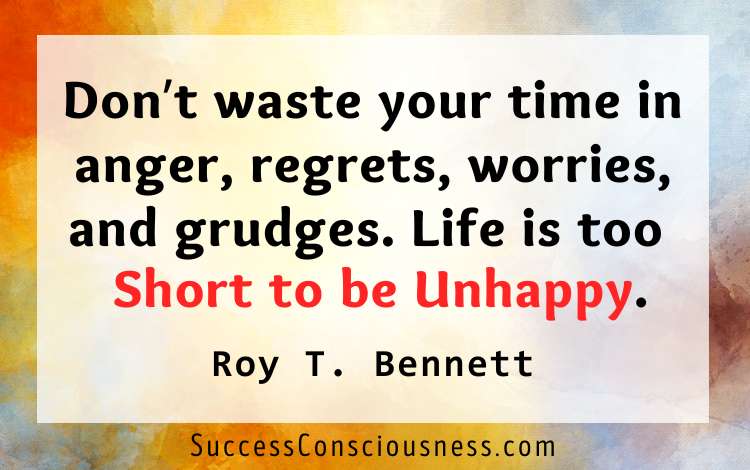
What are Worries and How to Overcome Them

By Remez Sasson

What are Worries?

  • Expectation of failure and problems.
  • Fears.
  • Thoughts about what might happen if…
  • A useless mental activity that wastes your time and energy.
  • Negative thoughts.
  • Low self-esteem.
  • Negative affirmations.

Why do you worry?

  • It is a habit of the mind.
  • Your mind is programmed to worry.
  • You assume that certain problems cannot be solved.
  • Fear of failure.
  • Going through negative experiences in the past.
  • Inability to reject unwanted thoughts.
  • Lack of mental discipline.
  • Lack of self confidence.
  • Lack of self esteem.
  • Lack of ambition and motivation.

[Read more...]

Are You Good At Giving Feedback? An Exercise in Clapping

Are You Good At Giving Feedback? An Exercise in Clapping
by Nancy Darling

My brother teaches middle school social studies, a job that requires him to give lots and lots of feedback. Some of it is called grading. A big part of his job is to teach kids to do a careful analysis, then present good, clear arguments that are well bolstered with facts. One of the hardest parts of his job is helping students to understand how to master this craft when every essay they write has slightly different demands and requirements.

Parents often spend a lot of time doing the same thing, although the behaviors we are looking for aren’t always as clear cut as the rubric for grading a persuasive essay. In her work on parenting style, Baumrind found that all parents had fairly clear ideas about how they want their children to behave, although they differ in how they help their children get there. Even if parents can’t always articulate them clearly, they can always tell that when their expectations have been violated. It’s when they get annoyed.

At work, supervisors do the same thing, judging employees’ performance based on how well it matches up to their internal sense of how the job should be done.

All of us – teachers, parents, and supervisors – are constantly passing judgments and providing feedback so that those we’re working with will perform better over time.

My brother shared this exercise with me. I think it does a good job of demonstrating what kind of feedback is most helpful and it’s one I often do in class. But it requires a little imagination.

The Clapping Contest: An Exercise for the Imagination

Imagine you are taking part in a clapping contest. I know it’s an odd thing to do, but just imagine it…..

Read the complete article:
Are You Good At Giving Feedback? An Exercise in Clapping

Source: www.psychologytoday.com

Yoga For Stress And Anxiety Relief

Yoga For Stress And Anxiety Relief
by Paul M. Jerard Jr.

Today’s lifestyles define the word, “stress.” More than 19 million Americans suffer from some from of anxiety on a regular basis. Part of what contributes to the increase in stress, and anxiety, is that very few people know how to manage their stress.

Some of those, who know how to manage stress, fail to create a plan of action. In a nutshell, Yoga can provide the means to cope and reduce stress. Allowing stress to become chronic, or permitting anxiety to take over one’s life, can be seriously detrimental to a person’s health.

Stress can cause a variety of health problems. Existing conditions, illness, and ailments, are worsened, if they are allowed to thrive through stress. Anxiety and stress can lead to a paralyzed existence, or inability, to function.

The good news is that yoga works to loosen the tension in the mind, body, and spirit. Even the medical community has begun to recognize what yogis have known for hundreds of years.

The core goal of yoga is to reach a state of tranquility, completeness, and peaceful union, of mental, emotional, physical, and spiritual health. Is there a better way to calm your worry?

The methods of breathing, and focused meditation, draw your mind away from stressful distraction. Visualization during breathing, and the performance of yoga postures, plant your mind in a place of calm.

Read the Article

Clearing Misunderstandings About Self Discipline

By Remez Sasson

Following the previous post, “Why You Need Self Discipline”, I would like to clarify several points, since it seems that are some misunderstandings of what self discipline is.

Some people believe that self discipline means being austere, severe and harsh on yourself and toward others. This is completely untrue! You can possess self discipline, and yet be loving, kind, considerate, open-minded and full of joy.

Self discipline is not some sort of senseless limitation that you put on yourself.

It is not an act of limiting your freedom of choice. On the contrary, doing whatever you feel like doing is not freedom at all. Acting on a whim, doing whatever you feel like doing at the moment is lack of freedom of choice, because this means acting in response to subconscious programming, and in reaction to external situations. It means that other people’s thoughts, words and actions move you to action, and not your judgment and common sense. This behavior doesn’t lead to inner and spiritual freedom.

The self discipline I am talking about is not a state of being cold, harsh, limited and conservative, as has been construed in various societies. It has nothing to do with self undoing, senseless suppression, bottling up feelings, being narrow-minded or lacking of freedom. It is a process in which your higher nature decides what to do and how to act. It is a power which everyone can develop to a greater or lesser degree.

[Read more...]

Why You Need Self Discipline

By Remez Sasson

Why do you need self discipline? What can it do for you, and is it worth the effort of developing it?

Here are a few reasons why you need self discipline:

1. Self-discipline builds inner strength, character and stability.

2. It helps you control appetite, impatience, anger and instinctive reactions.

3. It enables you to resist all kinds of unnecessary temptations, such as overeating, watching too much TV, gossiping, gambling or taking unnecessary risks.

4. Possessing self discipline enhances considerably your chances of achieving success in whatever you do.

5. All the good things in life need time to grow and yield fruit, which means you need tolerance, patience and persistence, all of which are the by-product of self discipline. This ability can help you in business, at work, in study, in sport, in meditation and in everything else.

6. People nowadays want instant results and instant gratification, but this is not always possible. People who excel in their chosen field usually study, make experiments, make mistakes and learn from them. They often prepare and train themselves, sometimes even for years, such as in sports for example. If they lacked discipline, which supplies inner strength and patience, they would have given up in the early stages.

7. A person with a disciplined mind controls what he/she says, and can therefore keep good relationships with other people.

8. A self disciplined person usually commands respect from other people, and doesn’t easily feel hurt or insulted by what people say or do.

9. A self disciplined person has more control over his/her thoughts and reactions.

10. With this ability it is easier to go through life and achieve goals.

This list can go on and on…

More about developing self discipline
Full duidance and exercises