

You’ve heard that affirmations can help you feel happier. You try one: “I am happy,” “joy flows through me effortlessly,” and instead of a lift, you feel a flicker of resistance, or worse, a small internal eye roll.
If this has happened to you, you haven’t failed at affirmations. You’ve simply hit the one problem almost nobody talks about: the gap between what you’re saying and what you actually believe in the moment.
This article isn’t a list of happiness affirmations; you’ll find those in our main guide to affirmations for happiness. This is about what to do when the words don’t land, so the practice can actually take root.
The Real Reason Affirmations Backfire
When you say “I am happy” while feeling flat, tired, or low, your mind doesn’t just receive the words; it also registers the mismatch. That mismatch produces a quiet counter-thought: that’s not true right now. Repeated enough times, this backfires: instead of building happiness, the practice builds a habit of noticing how far you are from it.
This isn’t a flaw in affirmations themselves. It’s a mismatch in calibration. The affirmation was pitched further ahead of where your mind currently stands than it could comfortably stretch to meet.
Signs Your Happiness Affirmations Are Miscalibrated
A few signals suggest the wording needs adjusting rather than abandoning the practice altogether:
- Saying the affirmation produces irritation, numbness, or an internal “no, it isn’t”
- You find yourself rushing through the words just to finish, rather than pausing on them
- The affirmation feels like a performance rather than something you mean
- You feel worse, not better, after a session
Download this free 3-step guide and start building focus and inner calm in just 5 minutes a day.
**Get the Free Guide**
None of these mean you’re “bad” at affirmations or that they don’t work for you. They mean the bridge between your current state and the stated affirmation is too long to cross in one step.
Closing the Gap: The Bridge Technique
Instead of jumping straight to the destination (“I am happy”), build a bridge statement that your mind can actually accept today. A few examples of how this looks in practice:
- Instead of “I am happy” → “I am willing to feel a little lighter today.”
- Instead of “Joy flows through me effortlessly” → “I am open to noticing small moments of joy.”
- Instead of “Happiness is my natural state” → “I am learning to let happiness back in.”
Each of these keeps the same direction and intention, but starts from a place your mind can honestly agree with. Over time, as the bridge statement starts to feel true, you can move it closer to the fuller affirmation.
This gradual approach tends to outperform “big leap” affirmations, especially for anyone who has been feeling low, stressed, or emotionally flat for a while.
Related: Affirmations: Meaning, Foundations, and the Real Power of Repeated Though
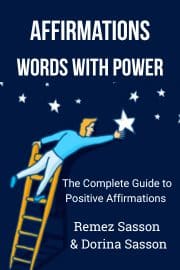
What You Repeatedly Say to Yourself Shapes What You Believe and Do.
Learn how to use affirmations effectively to rewire your thinking, build positive habits, and attract the outcomes you want — with over 900 affirmations for almost every goal and purpose.
Discover the Book →Affirming Happiness Without Denying What You Actually Feel
A subtler problem than disbelief is suppression. Some people use happiness affirmations to talk themselves out of sadness, frustration, or grief by repeating “I choose joy” as a way of pushing an unwanted feeling down. This rarely works for long, and it can leave the underlying emotion untouched and unresolved, quietly resurfacing later.
A more sustainable approach is to let the real feeling exist alongside the affirmation, rather than instead of it. In practice, this might sound like:
“I feel disappointed right now, and I am still willing to notice something good today.”
This isn’t a contradiction — it’s emotional honesty paired with intention. The affirmation isn’t there to erase what’s real; it’s there to keep a door open next to it.
What You Repeatedly Say to Yourself Shapes What You Believe and Do.
Learn how to use affirmations effectively to rewire your thinking, build positive habits, and attract the outcomes you want — with over 900 affirmations for almost every goal and purpose.
Discover the Book →Why Timing and Setting Change Everything
The same affirmation can land completely differently depending on when and how it’s said. A few adjustments that often make a noticeable difference:
Slow down. Rushed affirmations are processed as words, not as felt experience. Even five extra seconds of pause after saying a line changes how it’s absorbed.
Anchor it to a real memory. Before affirming “I am open to joy,” briefly recall one small moment, such as a conversation, a meal, or a quiet minute when you actually felt something close to that. This gives the mind a reference point instead of an abstraction.
Match your body to the words. Saying a happiness affirmation while frowning, hunched, or holding tension sends a conflicting signal. Even a small physical shift—unclenching your jaw, softening your shoulders—helps the statement feel congruent rather than forced.
Choose low-friction moments. Immediately after a stressful call or in the middle of a rushed morning is rarely the moment your mind is most receptive. A quiet transition right after waking, before a walk, or at the end of the day tends to work better.
When to Simply Let an Affirmation Rest
Not every affirmation needs to be forced into agreement today. Sometimes the most useful thing you can do is say the words gently, without demanding an immediate emotional shift, and let them sit as a seed rather than a switch.
Some affirmations take weeks of quiet repetition before they start to feel less like a statement and more like a fact. That lag is normal, not a sign of failure.
Building on a Foundation, Not Starting from Scratch
If you’re ready to move from occasional affirmations to a structured, guided practice, one built specifically to work through resistance and make happiness affirmations feel natural rather than forced, the Happy Words: Affirmations for Happiness course walks through this process step by step, with exercises designed to help the words genuinely take root.
The words themselves were never the obstacle. The bridge between where you are and what you’re affirming is what makes the difference, and once that bridge is in place, happiness affirmations stop feeling like a performance and start feeling like the truth.
What You Repeatedly Say to Yourself Shapes What You Believe and Do.
Learn how to use affirmations effectively to rewire your thinking, build positive habits, and attract the outcomes you want — with over 900 affirmations for almost every goal and purpose.
Discover the Book →Refined and updated with practical wisdom for 2026 by Remez Sasson.
If you find this content helpful, we would truly appreciate it if you mention or link to SuccessConsciousness.com.
About the Author
 Remez Sasson is the founder of SuccessConsciousness.com, a global resource established in 2001. With decades of personal experience and 25 years of professional digital publishing he has written many articles, and created 11 eBooks, and 16 digital courses. His teachings have helped readers worldwide cultivate inner peace, self-mastery, and inner strength, empowering them to effectively shape their lives.