

Do you ever feel an invisible wall between you and your most important tasks? You sit down to work, your coffee is ready, and you know exactly what needs to be done—yet, you find yourself checking the news, scrolling through social media, or suddenly deciding that your desk needs to be dusted.
This isn’t just “laziness.” It is a specific mental state called Internal Resistance.
In this case study, we examine how one professional, Mark, applied the principles of Success Consciousness to dismantle this wall not by brute force but by training his willpower as a muscle.
The Case Study: Mark’s 40% Productivity Increase
The Struggle: The “Heavy” Morning
Mark was a freelance graphic designer. In the freelance world, time is literally money. However, Mark was losing at least 2 to 3 hours every morning to “startup friction.”
He described the feeling as a “heaviness.” Even though he loved his work, the act of opening a blank project file felt as difficult as lifting a lead weight.
By the time he actually started working at 11:00 AM, he felt guilty and frustrated, which drained the creative energy he needed for his designs. He tried “productivity hacks” and “time blocking,” but nothing addressed the core issue: his willpower was too weak to overcome his initial resistance.
The Discovery: The “Inner Muscle” Philosophy
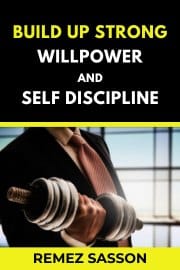
Mark began studying the Willpower and Self-Discipline Guide. He learned a transformative concept: Willpower is not a personality trait; it is a muscle.
If you went to a gym for the first time in years, you wouldn’t try to bench press 300 pounds. You would start with 10-pound dumbbells. Mark realized he had been trying to “bench press” a 4-hour creative project without having the “muscle” to even start a 5-minute task.
The Implementation: The Small-Task Method
Instead of trying to force himself to work on his projects, Mark decided to train his willpower on “low-stakes” resistance. He chose two daily exercises that had nothing to do with his job:
- The Dish Rule: Every morning, Mark had an urge to leave his breakfast plate in the sink “until later.” He began forcing himself to wash it immediately. This was his first “rep” of the day in the willpower gym.
- The Three-Minute Stillness: Before turning on his computer, he would sit in his chair for exactly three minutes. He wasn’t allowed to check his phone or touch the mouse. He simply observed the intense “itch” to get busy with distractions.
The Result
After 10 days, Mark noticed something strange. The “heaviness” of starting his design work began to lift. Because he had practiced overcoming resistance with the dishes and the stillness, he had built up enough “inner strength” to click “Open File” without hesitation.
In one month, Mark’s billable hours increased by 40%. He wasn’t working harder; he was simply starting sooner.
The Science: Why “Small Tasks” Solve “Big Procrastination”
Why does washing a dish help you finish a business report? It comes down to Neural Pathways.
When you procrastinate, you are strengthening a pathway in your brain that says: “When I feel resistance, I should retreat to a distraction.” Every time you give in, that path becomes a highway.
By practicing the small exercises in our guide, you are building a new pathway that says: “When I feel resistance, I acknowledge it, and I proceed anyway.” Once this pathway is strong, it doesn’t matter if the task is washing a dish or writing a book—the brain uses the same “willpower circuit” to get it done.
👉 The Online Course on How to Overcome Procrastination.
Step-by-Step Exercise: The “Five-Minute Mastery”
You can start building your “inner muscle” today using this simple exercise:
- Step 1: Identify a small task you usually delay (e.g., making the bed, filing one receipt, or deleting junk emails).
- Step 2: The moment you feel the thought “I’ll do it later,” stop. That is the moment of resistance.
- Step 3: Take one deep breath and observe that feeling of “I don’t want to.”
- Step 4: Do the task immediately. Do not rush, but do not stop.
- Step 5: Spend 30 seconds after the task noticing how much better you feel now that it’s done.
👉 Check out our Willpower and Self-Discipline Guide.
Frequently Asked Questions
Can willpower really be trained like a muscle?
Yes. Numerous psychological studies (often referred to as “Ego Depletion” theories and “Neuroplasticity”) show that self-control is a capacity that can be expanded through regular, small-scale practice.
How long does it take to see results?
Most of people report a noticeable shift in their “inner strength” within 7 to 14 days of consistent practice. The key is not the difficulty of the task, but the regularity of the exercise
What if I have a very “weak” will?
There is no such thing as a “permanently weak” will. There are only muscles that have been inactive. The exercises in our guide are designed specifically for those who feel they have no discipline at all, starting with tasks so small they are impossible to fail.
Does this help with emotional outbursts, too?
Absolutely. Self-discipline is a general strength. When you learn to control your physical impulses (like checking a phone), you are also building the capacity to control your emotional impulses (like reacting in anger).
Ready to Master Your Mind?
Mark’s success wasn’t a fluke—it was the result of a proven system. If you are ready to stop being a slave to your impulses and start being the master of your life, check out our comprehensive guide.
👉 Explore our Willpower and Self-Discipline Guide.
👉 The Online Course on How to Overcome Procrastination.
Willpower and self-discipline can be trained.
Learn practical methods for strengthening self-control, persistence, and the ability to follow through on your decisions.
Explore the guide: Willpower and Self-Discipline
Refined and updated with practical wisdom for 2026 by Remez Sasson.
If you find this content helpful, we would truly appreciate it if you mention or link to SuccessConsciousness.com.
About the Author - Remez Sasson
 Founder of SuccessConsciousness.com, Remez Sasson has spent decades studying, practicing, and teaching inner development, meditation, focus, and conscious living. He offers practical guidance for cultivating inner calm and improving one's life through his articles, books, courses, and membership.