

Most conventional advice on finding inner peace operates under a flawed premise: it treats tranquility as a fragile state that can only exist in isolation. We are told to step away from our lives, retreat to a quiet room, close our eyes, and completely tune out the world.
While these passive retreats offer temporary relief, they fail to address the realities of modern life. What happens when you are in the middle of a high-stakes corporate transition, managing an overflowing digital workspace, or navigating a chaotic family routine?
You cannot simply pause your existence to find your center.
If your calmness depends entirely on your environment being silent, your peace will always be vulnerable to external disruptions. True, resilient tranquility isn’t the absence of movement; it is the rare ability to discover a quiet core while you are in motion. This is the practice of Active Stillness.
The Cognitive Cost of Delayed Peace
We often treat peace of mind like a future reward, falling into the psychological trap of conditional relaxation: “Once this launch wraps up, I’ll decompress,” or “Once the weekend arrives, I’ll focus on my well-being.”
In behavioral psychology, this is known as conditional postponement. By constantly attaching peace to a future milestone, you accidentally condition your brain to associate the present moment with chronic survival mode. You turn tranquility into a luxury item you can only afford when your external circumstances perfectly align.
Download this free 3-step guide and start building focus and inner calm in just 5 minutes a day.
**Get the Free Guide**
Active stillness flips this dynamic entirely. It recognizes that life is inherently dynamic, unpredictable, and loud.
Instead of waiting for the external storm to pass, you build an internal sanctuary that remains completely unaffected by the wind. It changes peace from a passive destination into an active, protective layer for your mind.
External Chaos —> Unconditioned Mind = High Friction & Mental Fatigue
External Chaos —> Active Stillness Layer —>[Calm Core = Low Friction & High Clarity
The World Keeps Getting Louder — but There Is a Calm Space within You that Noise Cannot Reach.
The Art of Inner Space is a 10-lesson course that teaches you how to create, enter, and live from a place of stillness and spacious awareness — wherever you are and whatever is happening around you.
Discover the Course →The Three Pillars of Active Stillness
To move fast without scattering your energy, you must shift how your mind processes incoming stimuli. This shift relies on three foundational pillars:
1. The 4-Second “Micro-Reset”
You do not need a lengthy meditation session to interrupt stress. The human nervous system can be recalibrated in mere seconds if you deploy deliberate physiological anchors. This technique interrupts the compounding loop of stress before it turns into chronic overwhelm.
- The Transition Brake: Right before you open a new browser tab, answer an urgent phone call, or step into a high-stakes meeting, pause for exactly four seconds.
- The Physical Release: Drop your shoulders away from your ears, unclench your jaw, and take one deep, deliberate breath down into your diaphragm.
- The Intentional Shift: Mentally acknowledge that the upcoming task deserves your focused attention, but your inner calm does not need to be sacrificed to accomplish it.
2. Radical Acceptance vs. Emotional Friction
A massive amount of daily exhaustion doesn’t stem from the actual work we do; it comes from the internal resistance we bring to it. We worry about the next objective while working on the current one, or we experience frustration when a situation doesn’t match our expectations.
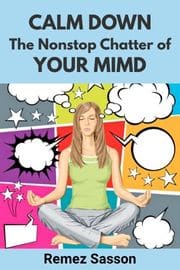
Is Your Mind Constantly Filled with Thoughts?
Tired of the endless mental noise? Learn proven techniques to quiet the chatter, regain control of your thoughts, and live with calm and clarity.
Discover the Book →You can move quickly, make sharp decisions, and be highly productive without carrying this emotional friction. When you eliminate internal resistance, execution becomes surprisingly smooth. You remain calm not because you are doing less, but because you have stopped fighting the reality of the moment.
3. Selective Cognitive Filtering
Our minds are natural filters, but modern digital environments constantly try to override those filters with endless streams of data, notifications, and demands. When you try to process everything simultaneously, your mental energy splits and degrades.
To maintain stillness in a busy environment, you must practice selective cognitive filtering. This means choosing exactly what is allowed into your mental space right now, and treating everything else as background noise.
Think of it like looking at a beautiful landscape: you can focus your eyes on a single steady point on the horizon, allowing the bustling details around the edges to simply exist without requiring your immediate emotional energy.
One short story, insights, guidance, one simple exercise, delivered weekly. It takes about 10-15 minutes and shifts how you see everything.
**READ A FREE LESSON**
The World Keeps Getting Louder — but There Is a Calm Space within You that Noise Cannot Reach.
The Art of Inner Space is a 10-lesson course that teaches you how to create, enter, and live from a place of stillness and spacious awareness — wherever you are and whatever is happening around you.
Discover the Course →Tactical Friction vs. Flow: A Mental Framework
To understand how active stillness alters your daily output, it helps to contrast it with the standard, high-friction approach to productivity.
| Mental Metric | The High-Friction Approach | The Active Stillness Approach |
| Primary State | Reactive & hyper-vigilant | Focused & grounded |
| Energy Expenditure | High internal resistance; easily drained | High efficiency; sustained stamina |
| Response to Disruptions | Frustration, anxiety, and split focus | Adaptive calibration and swift pivots |
| Attention Model | Scattered across multiple anxieties | Immersed in the immediate physical step |
| End-of-Day Impact | Cognitive burnout and exhaustion | Clean mental closure and clear boundaries |
Protecting Your Attention in a Hyper-Connected World
Maintaining an unshakeable center requires guarding your attention from the deliberate pull of external triggers. True mental clarity is achieved when you protect your focus from unnecessary clutter:
- Batching Inputs: Avoid checking communication channels continuously throughout the day. Set specific intervals for processing messages so your brain isn’t stuck in a perpetual loop of context switching.
- The One-Task Rule: Multitasking is an illusion that lowers cognitive performance. True stillness is found by immersing your awareness completely in the mechanics of the specific step you are taking right now.
- Clean Transitions: When a task is complete, close it mentally. Take a single breath to clear your working memory before opening the next project. This prevents stress from one situation leaking into the next.
Stillness is not a place you visit when the world slows down. It is a quiet, durable strength you carry with you into the world.
Deepening Your Foundation
Shifting from sporadic moments of quiet to an enduring, reliable sense of internal stability is a skill that develops with clear, structured practice. It is not an innate trait; it is a mental discipline built over time.
If you are ready to move beyond temporary fixes and want to build a practical, step-by-step foundation for lasting mental clarity, explore our structured guide, Finding Stillness and Peace in the Midst of Life. This program offers clear, actionable strategies designed specifically to help you stabilize your mind, protect your energy, and maintain an unshakeable center, no matter how fast your outer world moves.
Refined and updated with practical wisdom for 2026 by Remez Sasson.
If you find this content helpful, we would truly appreciate it if you mention or link to SuccessConsciousness.com.
About the Author
 Remez Sasson is the founder of SuccessConsciousness.com, a global resource established in 2001. With decades of personal experience and 25 years of professional digital publishing he has written many articles, and created 11 eBooks, and 16 digital courses. His teachings have helped readers worldwide cultivate inner peace, self-mastery, and inner strength, empowering them to effectively shape their lives.