

In our main guide to Emotional Detachment, we explored the philosophy of letting go. But how do you actually do it when you are in the middle of a stressful meeting or a heated argument?
This requires some training, which you can find here.
7 Exercises for Emotional Detachment
The following exercises are designed to be used in real-time. They are not just for meditation; they are for the “battlefield” of daily life.
Exercise 1: The Five-Second Buffer
The moment you feel a surge of anger, irritation, or anxiety, commit to a five-second pause.
- The Action: Do not speak. Do not type. Simply count to five slowly while focusing on the physical sensation of the emotion in your body.
- The Result: This pause creates a gap between the trigger and your reaction. It allows your rational mind to step in before your emotions take over.
Exercise 2: Labeling the “Emotional Weather”
We often say “I am angry” or “I am worried,” which identifies us with the emotion.
- The Action: Practice changing your internal language. Say, “I notice a feeling of anger arising” or “There is a cloud of worry passing through.”
- The Result: This simple shift in wording reminds you that you are the observer of the emotion, not the emotion itself.
Exercise 3: The “Not My Package” Visualization
When someone is venting, complaining, or being aggressive toward you, they are trying to “deliver” their emotional stress to you.
- The Action: Imagine them holding a heavy, dark package. In your mind, see yourself politely refusing to sign for it. You can hear their words, but you do not have to “own” the feelings behind them.
- The Result: This prevents “emotional contagion” and keeps you from feeling drained after social interactions.
Exercise 4: Shifting Attention to the Physical Present
Download this free 3-step guide and start building focus and inner calm in just 5 minutes a day.
**Get the Free Guide**
Emotional attachment thrives on mental “stories” about the past or future.
- The Action: When you feel yourself getting pulled into a mental loop, immediately shift your focus to a physical sensation. Feel the weight of your feet on the floor, the texture of the desk, or the temperature of the air on your skin.
- The Result: Physical sensations are always in the now. Shifting to them starves the emotional story of the energy it needs to grow.
Exercise 5: The “Five-Year Perspective” Test
We often get emotionally attached to “small dramas”, such as a rude comment, a minor mistake, or a delay.
- The Action: Ask yourself: “Will this matter to me in five years? In five months? Even in five days?”
- The Result: Most triggers fail this test. Realizing the insignificance of the event allows your mind to let go of the attachment instantly.
Stop Letting People and Situations Control How You Feel
Learn how to detach, stay calm, and protect your inner peace, no matter what happens.
Exercise 6: Conscious Observation of Thoughts
Sit quietly for two minutes. Instead of trying to stop your thoughts, watch them as if they were cars passing by on a road.
- The Action: Notice a thought appear, stay for a moment, and disappear. Do not follow the “car” down the road; stay on the sidewalk.
- The Result: This builds the “detachment muscle,” making it easier to ignore distracting or upsetting thoughts during the day.
Exercise 7: Releasing the Need to Control
Much of our emotional pain comes from wanting people or situations to be different from what they are.
- The Action: Pick one minor frustration today (like traffic or a slow internet connection) and silently say, “I accept this moment exactly as it is.”
- The Result: This practice of non-resistance is the core of emotional freedom.
Emotional Detachment as a Way of Being
At a certain point, emotional detachment stops being something you think about. It becomes the background of experience.
You gradually begin to respond instead of react, engage without entanglement, and live without constant inner tension.
Life feels simpler, not because it has fewer challenges, but because inner resistance has diminished.
The Quiet Strength of Detachment
Emotional detachment does not announce itself. It is quiet, steady, and often invisible to others. Yet it transforms how life is experienced.
You are no longer at the mercy of emotional tides. You are present, aware, and inwardly free.
This freedom does not isolate you. It connects you more deeply to life, without confusion or suffering. You feel more confident in daily life and in difficult situations.
One short story, insights, guidance, one simple exercise, delivered weekly. It takes about 10-15 minutes and shifts how you see everything.
**READ A FREE LESSON**
Take Your Training Further
These exercises are the first steps toward a life of poise and power. To master these techniques and turn them into a permanent state of mind, we recommend the deeper training found in the book Emotional Detachment for a Happier Life.
By applying these methods daily, you will soon find that you are no longer a passenger in the vehicle of your emotions—you are the driver.
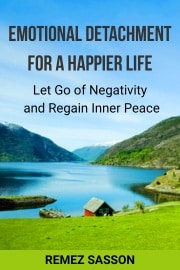
Do Other People's Moods and Words Affect You Too Much?
Learn how to stop taking things personally, let go of negative emotions, and stay calm and balanced — no matter what is happening around you.
Discover the Book →Refined and updated with practical wisdom for 2026 by Remez Sasson.
If you find this content helpful, we would truly appreciate it if you mention or link to SuccessConsciousness.com.
About the Author
 Remez Sasson is the founder of SuccessConsciousness.com, a global resource established in 2001. With decades of personal experience and 25 years of professional digital publishing he has written many articles, and created 11 eBooks, and 16 digital courses. His teachings have helped readers worldwide cultivate inner peace, self-mastery, and inner strength, empowering them to effectively shape their lives.