
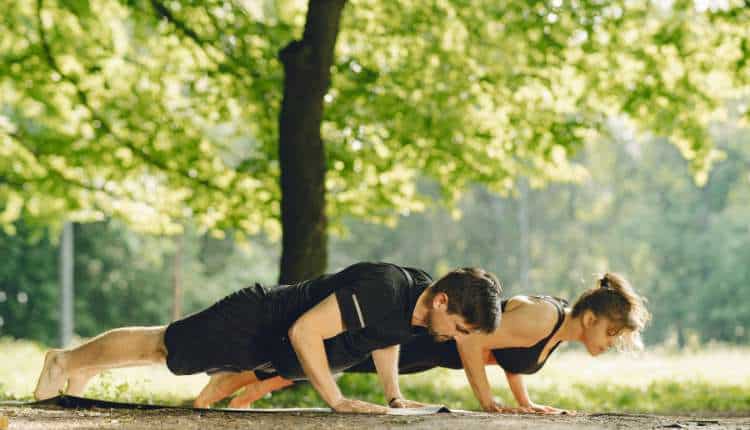
Most people think of exercise as something the body needs. A way to manage weight, improve health, or release tension accumulated during a long day. These are real benefits. But they are not the most interesting ones.
What research is increasingly showing is that regular physical exercise trains something far deeper than muscle tissue. It trains the capacity for self-regulation itself. The willpower to delay gratification.
The focus to stay with a task when discomfort arrives. The mental steadiness that allows you to act in accordance with your intentions rather than being pulled around by your impulses.
Inner strength is not simply a trait some people are born with, and others are not. It is a capacity that develops through consistent practice. And one of the most reliable training grounds for that practice is the simple, repeatable act of choosing to move your body when a part of you would rather not.
The Science Behind Exercise and Self-Discipline
The relationship between physical exercise and self-regulatory capacity is not a motivational metaphor. It has been studied directly.
A 2025 study published in Frontiers in Sports and Active Living examined the effects of long-term physical exercise on different types of self-control.
Download this free 3-step guide and start building focus and inner calm in just 5 minutes a day.
**Get the Free Guide**
Long-term exercisers showed significantly better persistent self-control than non-exercisers. It is worth noting that effects on inhibitory self-control were less consistent, suggesting the benefits are real but not uniform across all types of self-regulation.
This builds on earlier foundational research. A landmark study by Oaten and Cheng, published in the British Journal of Health Psychology, followed participants through a structured exercise program and found longitudinal gains in self-regulation across multiple domains – not only in exercise adherence, but also in study habits, emotional regulation, and resistance to impulsive behaviors.
The exercise training appeared to strengthen a general self-regulatory capacity that transferred beyond the gym.
Researchers Angela Duckworth and Martin Seligman found that self-discipline outdoes IQ in predicting academic performance in adolescents. Their work, alongside a growing body of research, points in the same direction: the capacity for willpower and self-discipline appears to be one of the most important factors in human performance, and research suggests it is trainable.
It’s Time to Gain Willpower and Self-Discipline
Learn simple methods for strengthening self-control and following through on your decisions.
Explore the guide: Build Up Your Willpower and Self-Discipline
Why Exercise Is a Training Ground for Willpower
The likely mechanism behind this connection is worth exploring, because it helps explain not just the what, but the why – even if the exact pathways are still being studied.
The Repetition of Doing What You Said You Would Do
Every time you commit to a workout and follow through – especially on the days when the commitment feels inconvenient – you practice a specific inner act. You feel resistance, but you act in accordance with your intention anyway. You choose the longer reward over the immediate comfort.
This is not simply physical training. It may be the repeated exercise of the same mental faculty that researchers call self-control.
Roy Baumeister proposed an influential model: self-regulation may function similarly to a muscle – fatigable by overuse in the short term, but potentially strengthened through sustained training over time.
The field no longer treats this as a complete explanation, and subsequent research has complicated the picture. But the core observation – that consistency in one domain can support self-regulation in others – remains backed by evidence.
Research published in Frontiers in Public Health found that self-regulatory training programs can significantly counter prior mental exertion and improve subsequent physical and cognitive performance, with effects across multiple domains, including emotional and cognitive functioning.
Exercise, done consistently over months and years, may provide that kind of sustained training.
The Role of Discomfort
One aspect of exercise that is rarely discussed in the context of inner development is the deliberate encounter with discomfort. Every workout contains moments when the body signals that stopping would be easier – a burning sensation in the legs, difficulty breathing, fatigue in the muscles. These are not reasons to stop. They are the actual training.
Learning to distinguish between the signal that says “this is uncomfortable” and the signal that says “this is genuinely harmful” is one of the most practically useful skills that regular exercise develops. It is the same skill that allows a person to sit with the discomfort of a difficult conversation, a challenging task, or an unwanted emotion without immediately trying to escape it.
This capacity – to stay present with discomfort without being controlled by it – is one of the foundational inner strengths that personal development traditions have pointed to for centuries. Exercise is one of the most accessible daily practices for developing it.
It’s Time to Gain Willpower and Self-Discipline
Learn simple methods for strengthening self-control and following through on your decisions.
Explore the guide: Build Up Your Willpower and Self-Discipline
Building the Identity of Someone Who Follows Through
There is another dimension to this that psychology research is increasingly exploring. Each time you follow through on a commitment you made to yourself, you reinforce a particular self-concept. You become, in your own experience, someone who does what they say they will do.
A widely used framework in habit psychology holds that the most durable behavioral changes occur when a person begins to see themselves differently, not as someone trying to be disciplined, but as someone who is disciplined.
James Clear’s Atomic Habits popularized this idea and drew on self-concept research to make it accessible. It is a useful practical lens, even if it is not itself a primary scientific finding. Exercise provides daily repetitions of this kind of identity reinforcement in a way that is direct, measurable, and hard to deny.
What accelerates this process is having an external structure that removes the daily decision of whether to show up. Personal training apps like FitBudd are built around exactly this: structured programs, defined sessions, and built-in accountability that makes following through easier in the early stages – before discipline itself has been fully internalized.
The external scaffold supports the development of internal capacity, and eventually, the scaffold is no longer needed.
Focus and Cognitive Clarity as Byproducts of Regular Movement
Willpower and self-discipline are not the only capacities that regular exercise may support. Focus and cognitive clarity also respond to physical training, as neuroscience research has begun to document.
Aerobic exercise is associated with increases in brain-derived neurotrophic factor (BDNF), which is a protein sometimes called fertilizer for the brain, though that is a metaphor, not a precise scientific description.
BDNF supports neural connections, particularly in the hippocampus, the region associated with memory and learning. Reviews of the literature link regular aerobic exercise with improvements in working memory and attention, though effects vary by individual, exercise type, and duration.
For anyone engaged in meditation, contemplative study, or conscious self-development, this is not a peripheral consideration. A clearer, less reactive mind that can sustain attention is a more useful instrument for every kind of inner work. Practical methods for developing self-discipline and focus alongside physical training can compound these benefits significantly over time.
The Post-Exercise Window
An often-noted practical observation: many people find the period immediately following exercise to be a good time for focused mental work, meditation, or deliberate study.
Several neurological changes occur after exercise, including shifts in cortisol, neurotransmitter activity, and blood flow. These are associated with improvements in mood and alertness for many people.
The exact sequence and size of these effects vary, and the research is not definitive enough to treat this as a universal rule. But using post-exercise time for focused work or quiet reflection is a plausible habit worth experimenting with.
Consistency as the Core Practice
None of these benefits accumulate from occasional exercise. They develop through consistency. And consistency is precisely what most people find most difficult to maintain.
Research suggests that the psychological benefits of exercise – improvements in self-regulation, focus, and mood – tend to build gradually over months of regular practice. They do not arrive dramatically after a single session. They emerge through repetition, in the same way that any inner capacity emerges through sustained practice.
This is why the structure and accountability around exercise matter as much as the exercise itself.
Many people understand intellectually what they should do. The gap between that understanding and consistent action is where most development stalls. A structured program, a defined schedule, and some form of accountability bridges that gap more reliably than motivation alone.
The Deeper Principle
There is a broader principle underlying everything discussed here. The inner capacities we most want – willpower, self-discipline, focus, emotional steadiness – do not develop through reading about them or thinking about them. They develop through doing. By repeatedly choosing the harder option, the choice may become less hard over time.
Exercise is one of the most immediate, accessible, and repeatable laboratories for this kind of development. It asks the same thing of you every time: choose effort over ease. Choose your intention over your impulse. Stay when it would be simpler to stop.
Each repetition of that choice, over days, months, and years, builds something that extends far beyond physical fitness. It builds the inner conditions from which greater steadiness, focus, and conscious action can naturally arise.
Do You Start Things but Struggle to Finish Them?
Motivation comes and goes — but discipline stays. Learn practical techniques to strengthen your willpower and self-discipline, beat procrastination, and follow through on your goals.
Discover the Book →While guest articles offer varied perspectives, our core work focuses on helping you build genuine inner strength, mental focus, and self-mastery from the inside out.
👉 Explore Our Practical Courses for Inner Transformation