
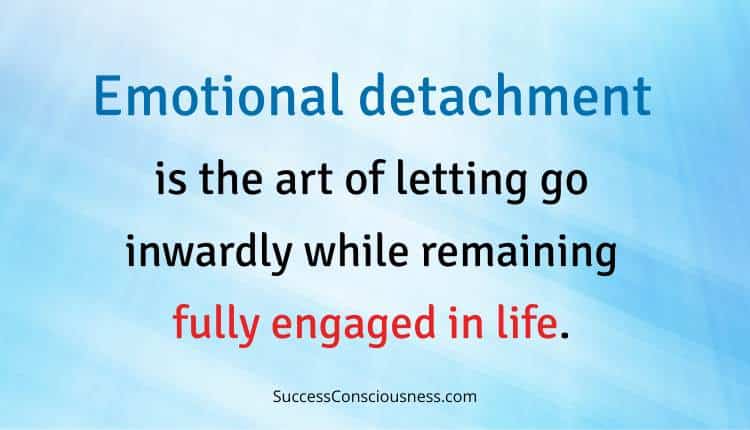
Are you tired of being at the mercy of your emotions?
Most people discover emotional detachment only after years of emotional exhaustion, worn out by constant worry, inner conflict, and the strain of being “too involved” in every situation.
True detachment is not about shutting down; it is a gradual inner shift that arises from deep understanding. It allows you to:
- Remain fully human, loving, and responsive.
- Stay calm even when “emotional waves” arise within you or from others.
- End the tyranny of impulsive reactions over your inner state.
It is the result of seeing how unnecessary suffering arises from identification and inner clinging.
In short, it does not remove emotions from life; it removes the suffering from emotions.
👉 Browse our collection of articles on letting go and detachment.
Key Benefits of Emotional Detachment:
| Without Detachment | With Emotional Detachment |
| Every insult ruins your day. | You hear the words, but stay calm. |
| You absorb others’ stress. | You offer help without feeling drained. |
| Overthinking leads to anxiety. | Thoughts pass like clouds in the sky. |
| You react impulsively. | You choose your response wisely. |
- Living Inside Emotional Reactions
- Detachment vs. Indifference: The Vital Distinction
- Emotional Detachment in Daily Life, Relationships, and Society
- Spotlight: Healthy Detachment in Your Relationships
- How Emotional Burdens Are Transferred
- Emotional Detachment and Inner Strength
- Emotional Detachment in the Workplace
- Social Life and Emotional Noise
- Emotional Detachment and Responsibility
- Emotional Detachment and Personal Identity
- A Quiet but Profound Shift
- Emotional Detachment, Inner Peace, and a Lighter Way of Living
- The Eastern View of Detachment and Non-Attachment
- Practical Training for Emotional Detachment
- Frequently Asked Questions About Emotional Detachment
- Is emotional detachment the same as emotional numbness?
- Can emotional detachment make relationships cold or distant?
- Does emotional detachment mean ignoring problems?
- Is emotional detachment compatible with compassion?
- How is emotional detachment different from suppression?
- Can emotional detachment be practiced in daily life?
- Does emotional detachment reduce motivation or ambition?
- Is emotional detachment related to Eastern teachings?
- How long does it take to develop emotional detachment?
- Conclusion: Emotional Detachment as Inner Freedom
Living Inside Emotional Reactions
Most people live inside their emotional reactions without realizing it. Thoughts appear, emotions follow, and behavior reacts almost instantly. There is little space between what happens and how it is experienced internally.
This happens repeatedly throughout the day:
- A remark is made, and irritation arises
- An expectation is unmet, and disappointment takes hold
- A tone of voice is perceived as dismissive, and tension spreads through the body
These reactions are not consciously chosen. They occur automatically, conditioned by past experiences, habits of thinking, and emotional memory. The mind interprets situations, assigns meaning, and reacts before awareness has a chance to intervene.
Because this process is so familiar, it feels natural. People assume that emotions must be obeyed, expressed, or acted upon immediately. They rarely question whether every emotional impulse deserves their full attention and energy.
Over time, this constant emotional engagement can lead to fatigue. The mind becomes restless, the nervous system remains alert, and inner peace feels fragile and dependent on circumstances. When things go smoothly, there is relief. When they do not, tension returns.
Emotional detachment begins when this pattern is noticed and understood.
Do you react too quickly or feel emotionally drained?
Learn how to stay centered and unaffected.
Detachment vs. Indifference: The Vital Distinction
A common fear is that practicing detachment will make you cold, uncaring, or emotionally numb. In reality, true emotional detachment is the opposite of indifference.
While indifference builds walls that shut people out, detachment builds healthy boundaries that allow you to love more deeply without being overwhelmed.
Understanding this distinction is the key to practicing detachment safely and effectively without losing your humanity.
Read the Full Guide: Detachment vs. Indifference: Are You Letting Go or Just Shutting Down?
For a deep dive into the psychology of a calm mind and staying centered, we recommend our book: Emotional Detachment for a Happier Life.
Emotional Detachment as Inner Space
At its essence, emotional detachment creates space.
This space appears quietly, yet it changes everything. It is the space:
- Between a thought and the belief that it must be true
- Between an emotion and the assumption that it defines who you are
- Between an external event and your inner state
Without detachment, emotions pull awareness inward and narrow perception. The mind becomes absorbed in reaction, replaying, and resisting. With detachment, awareness remains open and spacious. Emotions still arise, but they are seen as temporary movements, not absolute realities.
This shift, from immersion to observation, is the foundation of emotional detachment.
Why Emotional Detachment Feels Unnatural at First
Many people resist emotional detachment because it challenges deeply held assumptions about sincerity and authenticity.
From an early age, we are conditioned to believe that strong emotional reactions prove that we care. Sharing other people’s pain is interpreted as a sign of understanding and empathy. Emotional intensity is equated with truth.
The fear surrounding detachment stems from a misunderstanding of its nature. Detachment does not separate you from life; it separates you from unnecessary suffering.
Do you react too quickly or feel emotionally drained?
Learn how to stay centered and unaffected.
Emotional Involvement and the Inner Burden We Carry
A significant portion of emotional suffering comes not from life itself, but from how deeply emotional burdens are carried, both your own and those of others.
People speak from stress, frustration, or unresolved inner conflict. Words are often charged with emotion. Tone, facial expression, and behavior convey tension even when nothing explicit is said.
Without emotional detachment, this emotional charge is absorbed. You may notice that after certain conversations, you feel drained, tense, or unsettled, even though nothing objectively serious occurred.
This happens because emotional energy is unconsciously transferred through:
- Complaints and emotional venting
- Criticism or subtle negativity
- Anxiety expressed through tone or silence
Emotional detachment does not block communication. It prevents emotional overload.
You hear what is said without carrying it inward. You understand emotions without merging with them. This creates emotional clarity rather than emotional isolation.
Letting Go as an Inner Attitude
Letting go is an essential aspect of emotional detachment, but it is often misunderstood. Letting go does not mean forgetting experiences, abandoning responsibility, or denying reality. It means releasing the inner grip that keeps emotional reactions alive long after the situation has passed.
The mind has a tendency to hold onto:
- Past conversations and imagined arguments
- Expectations of how others should behave
- Mental images of how situations should unfold
- Emotional interpretations that no longer serve
This holding keeps emotions circulating internally, even when no action is required.
Emotional detachment teaches the art of letting go—not as an act of force, but as an act of understanding. When you clearly see that holding onto emotional reactions does not bring clarity, peace, or effectiveness, the grip naturally loosens.
Letting go becomes a natural consequence of insight, detachment, the development of a calm mindset, and widening one’s perspective.
Emotional Attachment and Inner Dependence
Emotional attachment binds your inner state to external conditions and to the past. When attached, peace depends on how others behave, how situations unfold, and whether expectations are met.
This attachment often hides beneath positive intentions. You may care deeply, yet feel anxious. You may be devoted, yet feel tense. You may be responsible, yet feel overwhelmed.
These are not signs of love or commitment. They are signs of emotional dependence.
Emotional detachment restores inner independence. It allows you to engage fully without surrendering inner balance. You remain involved, but not entangled.
This does not weaken relationships or responsibilities. It strengthens them by removing emotional strain.
Detachment Without Withdrawal
One of the most important clarifications is this: emotional detachment does not require withdrawing from life.
You do not need to distance yourself from people, avoid situations, or reduce involvement. Detachment is internal, not external.
You can be active, engaged, communicative, and responsible, while inwardly free. Detachment is not something others necessarily notice. It is an inner stance, not a visible behavior.
The more this is understood, the more natural detachment becomes.
The First Quiet Shift
Emotional detachment begins with a subtle realization: Not every emotional reaction requires full participation.
This realization alone changes how you relate to thoughts, feelings, and situations. You begin to notice reactions instead of being swept away by them. You begin to pause, even briefly. Awareness enters where habit once ruled.
You need to realize and accept the fact that getting emotionally entangled in other people’s negative feelings, fears, or worries does not help them and is harmful to you. You can be friendly, loving, and kind without allowing others’ feelings, and yours also, overwhelm you.
This is not suppression. It is choosing calm, clear thinking and not allowing other people’s feelings to manipulate you.
From here, emotional detachment slowly begins to appear.
Do you react too quickly or feel emotionally drained?
Learn how to stay centered and unaffected.
Emotional Detachment in Daily Life, Relationships, and Society
As emotional detachment begins to develop, its effects are first noticed not in dramatic moments, but in ordinary situations. Daily life becomes the training ground. Conversations feel lighter. Reactions soften. Situations that once triggered tension lose much of their emotional charge.
This change does not happen because life becomes easier. It happens because the inner relationship to life changes.
Instead of being pulled into every emotional movement, awareness remains present. Instead of reacting automatically, there is a brief pause. In that pause, clarity appears.
This is where emotional detachment reveals its real value, not as an abstract idea, but as a living inner capacity.
Spotlight: Healthy Detachment in Your Relationships
One of the most vital areas where detachment creates freedom is in our connections with others. True emotional detachment is not about becoming cold; it is the art of loving without losing yourself.
When we practice healthy detachment in relationships, we stop taking things personally, set firm emotional boundaries, and support loved ones without absorbing their stress or anxiety.
Read the Full Guide: Healthy Emotional Detachment in Relationships
For a complete step-by-step system on staying calm and centered in any relationship, we highly recommend our book, Emotional Detachment for a Happier Life.
How Emotional Burdens Are Transferred
One of the most practical benefits of emotional detachment is the ability to avoid absorbing emotional burdens from others.
People often carry unresolved stress, frustration, disappointment, or fear. These inner states are expressed not only through words, but through tone, body language, silence, and behavior. Emotional energy is transmitted constantly, often unconsciously.
Without detachment, this energy is absorbed. You leave conversations feeling heavy, tense, or unsettled. You replay words mentally. You carry emotions that did not originate within you.
Emotional detachment creates a psychological boundary. It is not a barrier, but an inner filter.
- You can hear emotional expressions without internalizing them.
- You can be present without becoming burdened.
- You can support without absorbing.
This does not reduce compassion. It prevents emotional exhaustion.
Do you react too quickly or feel emotionally drained?
Learn how to stay centered and unaffected.
Emotional Detachment and Inner Strength
True inner strength is not forceful. It is stable. A person who lacks emotional detachment may appear strong, assertive, or expressive, yet be inwardly reactive and easily disturbed. A detached person may appear calm and quiet, yet possess remarkable resilience.
Emotional detachment strengthens the inner core. It reduces vulnerability to emotional manipulation, pressure, and external turbulence.
This strength expresses itself subtly:
- In the ability to pause before responding
- In the capacity to remain calm under pressure
- In the ability to act wisely and with common sense
Emotional detachment helps you stay calm, strong, and stable in situations where others get overwhelmed and distressed.
Emotional Detachment in the Workplace
Modern work environments are emotionally demanding. Expectations, deadlines, competition, criticism, and uncertainty create constant emotional stimulation.
Without emotional detachment, work stress can easily spill into the inner life. Thoughts replay after hours. Tension accumulates. Self-worth becomes tied to outcomes and approval.
Emotional detachment changes the relationship to work.
- You still perform responsibly.
- You still care about quality.
- But your inner balance no longer depends entirely on results.
Criticism is received without emotional collapse. Pressure is handled without panic. Mistakes are addressed without self-condemnation.
Detachment allows you to function more effectively, not less.
Social Life and Emotional Noise
Beyond personal relationships and work, emotional detachment becomes essential in interactions in society.
News, opinions, social media, and public discourse are saturated with emotional charge. Fear, anger, outrage, and anxiety circulate constantly. Without detachment, the mind absorbs this noise, even when there is no direct involvement.
Emotional detachment allows you to remain informed without becoming overwhelmed. You can observe events without internal agitation. You remain aware without emotional saturation.
This does not mean ignoring reality. It means engaging with reality without inner disturbance.
Emotional Detachment and Responsibility
A common misunderstanding is that detachment reduces responsibility. In truth, it refines responsibility.
When emotionally attached, responsibility is mixed with anxiety, guilt, and fear. Actions are driven by emotional pressure.
With detachment, responsibility becomes clearer. You act because action is appropriate, not because emotion demands it. Decisions are made with calm consideration rather than emotional urgency.
Detachment does not reduce care. It removes emotional distortion. You begin to see things from a broader perspective, without emotions or thoughts clouding your judgment.
Emotional Detachment and Personal Identity
Many emotional reactions are tied to identity, depending on how we see ourselves, how we want to be seen, and how we fear being seen.
- A perceived insult threatens identity.
- A disagreement challenges self-image.
- A failure feels like a personal verdict.
Emotional detachment loosens this identification. You begin to see that thoughts and emotions are experiences, not definitions of who you are. You stop being attached to them.
This creates inner freedom. Identity becomes lighter, more flexible, less defensive.
A Quiet but Profound Shift
As emotional detachment deepens, something subtle changes. Life feels less heavy. Situations unfold without constant inner commentary. Emotional reactions still arise, but they pass more easily.
You stop fighting emotions and are no longer carried by them. You are aware of them but not overwhelmed by them. You feel free, happy, and light.
Emotional Detachment, Inner Peace, and a Lighter Way of Living
As emotional detachment increases, it becomes a natural habit. It simply expresses itself as calmness, clarity, and inner steadiness in the midst of ordinary life.
This does not mean that emotions disappear. It means emotions no longer dominate awareness. They arise, move, and dissolve without leaving long trails of mental disturbance behind them.
At this stage, emotional detachment becomes deeply connected with inner peace. The more detached you are, the more peaceful you become.
Do you react too quickly or feel emotionally drained?
Learn how to stay centered and unaffected.
Emotional Detachment and Inner Peace
Inner peace is often imagined as a special state that appears when life becomes quiet and predictable. In reality, inner peace has very little to do with external conditions. It emerges when the inner world is no longer constantly disturbed by emotional reactions.
Without emotional detachment, peace is fragile. It depends on people being cooperative, situations unfolding smoothly, and thoughts remaining pleasant. Any disruption threatens inner balance.
With emotional detachment, peace becomes more stable. You may still face challenges, disagreements, and uncertainty, but they no longer invade the inner space in the same way. There is a quiet center that remains unaffected even while action continues on the surface.
This is not emotional numbness. It is emotional clarity.
The Softening of Inner Resistance
Much emotional suffering comes from resistance, from the inner “no” toward what is happening. The mind resists events, words, feelings, and even its own thoughts. This resistance creates tension and prolongs emotional reactions.
As emotional detachment deepens, resistance softens, and you stop fighting thoughts, arguing with emotions, and mentally replaying situations in an attempt to change them.
You just stay calm, unaffected mentally and emotionally by events or people, and able to handle what you meet in life effectively.
This is not passivity. It means you stop adding emotional friction to reality. From this place, responses become clearer and more effective.
Detachment and the Flow of Life
When emotional attachment loosens, life begins to feel more fluid. Situations move more freely through awareness. Experiences are allowed to complete themselves without being endlessly replayed in the mind.
This creates a sense of inner lightness.
You notice that:
- Emotional reactions end more quickly
- Thoughts lose urgency
- Situations feel less heavy
Life still contains difficulty, but it no longer feels oppressive. You feel calm, relaxed, strong, and able to handle whatever you meet.
This lightness is not superficial positivity. It is the natural result of not carrying unnecessary emotional weight.
Emotional Detachment and Personal Growth
Emotional detachment does not block growth; it supports it.
When emotionally attached, growth is often distorted by fear, self-judgment, and emotional pressure. You push yourself harshly or avoid challenges altogether. Mistakes feel threatening rather than informative.
With detachment, growth becomes more honest.
- You can see limitations without self-condemnation.
- You can learn from mistakes without emotional collapse.
- You can change habits without inner struggle.
Detachment allows you to look at yourself clearly, without emotional distortion.
The Eastern View of Detachment and Non-Attachment
In Eastern wisdom traditions, detachment and non-attachment are not moral ideals. They are practical insights into how suffering is created and how it can dissolve.
It is an integral and essential part of the way toward inner awakening and self-realization.
Detachment appears gradually and naturally with meditation practice, and it helps deepen meditation.
The understanding is simple and direct: suffering arises not from experience itself, but from clinging to experience, and clinging to thoughts, emotions, outcomes, and identities.
Detachment does not ask you to abandon life. It asks you to stop clinging inwardly.
You still act, choose, and care, but you no longer bind your inner state to every experience.
This is freedom within life, not freedom from life.
Emotional Detachment and Happiness
Happiness is often pursued through emotional stimulation, seeking pleasurable feelings, exciting experiences, and emotional highs. While these moments can be enjoyable, they are unstable and short-lived.
These are more about moments of pleasure, not happiness.
Emotional detachment shifts the source of happiness.
Instead of depending on emotional intensity, happiness arises from inner ease and calm. There is contentment without constant stimulation. Joy appears quietly, without demand.
This happiness is less dramatic, but far more reliable.
It comes from:
- Reduced inner conflict
- Greater mental clarity
- Emotional balance
- A sense of inner sufficiency
- A calm mind
Detachment does not remove joy. It removes the anxiety around joy. When there is anxiety, restlessness, and a whirlpool of feelings, happiness disappears. When they are removed, and this is what emotional detachment does, happiness appears.
This is why emotional detachment leads to happiness.
Emotional Detachment and Compassion
Some ask whether compassion disappears when there is emotional detachment. The answer is that it does not.
When emotional reactions dominate, compassion is often mixed with personal distress. You feel overwhelmed by others’ pain, which can lead to withdrawal, frustration, or emotional fatigue.
With detachment, compassion becomes clearer.
- You can understand suffering without absorbing it.
- You can offer support without losing inner balance.
- You can care without becoming emotionally burdened.
This makes compassion sustainable.
Emotional Detachment and Freedom from Emotional Patterns
As detachment grows, emotional patterns that once seemed automatic begin to lose strength. Reactions that once dominated behavior soften or dissolve entirely.
You may notice that situations that previously triggered strong emotions now produce little reaction. Not because you are suppressing feelings, but because the underlying identification has weakened.
This is a sign of real transformation.
The mind no longer feeds old emotional loops. Awareness sees them clearly, and because they are seen, it becomes easier to avoid them.
Practical Training for Emotional Detachment
Emotional detachment is a skill that grows stronger with consistent practice. To truly master it, you must move beyond theory and train your mind to remain calm when the “emotional weather” becomes turbulent.
We have created a dedicated guide featuring 7 Practical Exercises to help you develop an “inner buffer,” stop overthinking, and protect your energy from external negativity.
Go to the Guide: 7 Practical Exercises for Mastering Emotional Detachment
For the most comprehensive training and advanced techniques, see our book: Emotional Detachment for a Happier Life.
The Quiet Strength of Detachment
Emotional detachment does not announce itself. It is quiet, steady, and often invisible to others. Yet it transforms how life is experienced.
You are no longer at the mercy of emotional tides. You are present, aware, and inwardly free.
This freedom does not isolate you. It connects you more deeply to life, without confusion or suffering. You feel more confident in daily life and in difficult situations.
Final Reflections: Living Lightly and Fully
Emotional detachment is not about becoming less human. It is about becoming less burdened.
You still feel, you still care, and still participate, but you do so with clarity, balance, and inner peace.
Life continues to unfold, unpredictable and imperfect. Emotions continue to arise and pass, and people remain complex. Yet within all of this, there is space, and in that space, there is freedom.
Frequently Asked Questions About Emotional Detachment
Is emotional detachment the same as emotional numbness?
No. Emotional numbness is a shutdown of feeling, often caused by overwhelm or suppression. Emotional detachment is awareness without identification. You still feel emotions, but they no longer dominate your inner state or control your reactions.
Can emotional detachment make relationships cold or distant?
True emotional detachment does the opposite. It removes emotional pressure, fear, and reactivity from relationships, allowing warmth, understanding, and respect to grow. You can be loving and caring without being emotionally dependent or reactive.
Does emotional detachment mean ignoring problems?
No. Emotional detachment does not mean avoidance or denial. It means facing situations clearly, without emotional distortion. Problems are addressed more effectively when reactions do not cloud judgment.
Is emotional detachment compatible with compassion?
Yes. When you are not overwhelmed by emotional reactions, you can understand others more clearly and respond with steadiness instead of emotional strain.
How is emotional detachment different from suppression?
Suppression pushes emotions away, creating inner tension. Emotional detachment allows emotions to arise and pass naturally, without resistance and without identification.
Can emotional detachment be practiced in daily life?
Yes. Emotional detachment develops naturally through awareness in everyday situations, conversations, work, relationships, and challenges. It does not require isolation, special conditions, or withdrawal from life.
Does emotional detachment reduce motivation or ambition?
No. It removes emotional anxiety from action. Motivation becomes calmer, more focused, and more sustainable when it is not driven by fear, pressure, or emotional dependency.
How long does it take to develop emotional detachment?
There is no fixed timeline. Emotional detachment grows gradually. Small shifts in awareness accumulate over time, leading to lasting inner change.
Conclusion: Emotional Detachment as Inner Freedom
Emotional detachment is a way of relating to life from a place of inner calm rather than emotional compulsion.
When emotional detachment develops, you do not become less human. You become less burdened. You feel without drowning, care without clinging, and act without being driven by inner turbulence.
Life continues to present challenges. People remain imperfect. Situations unfold in unexpected ways. Emotional detachment does not remove these realities, but it changes how deeply they disturb the inner world.
With detachment, reactions soften. Awareness expands. Inner peace becomes more stable, not because circumstances are controlled, but because you are no longer controlled by them.
This is not withdrawal from life. It is freedom within life.
When emotional detachment becomes part of your inner attitude, you live more lightly, respond more wisely, and experience life with greater balance, clarity, and quiet strength.
👉 Browse our collection of articles on letting go and detachment.
Recommended reading:
Meditation: A Complete Guide to Training the Mind
Inner Peace: Meaning, Practice, and Inner Stability
Inner Awakening: Opening the Mind, Expanding Awareness
Practical Spirituality: Living Beyond Ego in Everyday Life
What’s next?
This article focuses on understanding emotional detachment as an inner attitude and way of relating to life. Deeper practical training and structured guidance are explored in our book Emotional Detachment for a Happy Life.
Want more peace and fewer emotional reactions?
Learn practical ways to remain calm, steady, and unaffected by other people’s behavior.
Explore the guide: Emotional Detachment for a Happier Life
Refined and updated with practical wisdom for 2026 by Remez Sasson.
If you find this content helpful, we would truly appreciate it if you mention or link to SuccessConsciousness.com.
About the Author - Remez Sasson
 Founder of SuccessConsciousness.com, Remez Sasson has spent decades studying, practicing, and teaching inner development, meditation, focus, and conscious living. Through articles, books, courses, and ongoing weekly lessons, he offers practical guidance or cultivating inner calm, greater awareness in everyday life, and ways to improve one's life.