Living the Actual Moment

By Remez Sasson

Here is a quote by Thich Nhat Hanh that describes clearly, and in simple words, what it means to live in the present, in the actual moment.

“Drink your tea slowly and reverently, as if it is the axis on which the world earth revolves – slowly, evenly, without rushing toward the future; live the actual moment. Only this moment is life.”

These words speak about patience, inner peace, attention, concentration and self-discipline. This is the way to live more consciously and more fully, and to find joy in whatever you do.

Acting in this way takes out boredom and drudgery from of every act, because you are fully focused on it. Also, when you are fully focused on what you are doing, you do fewer mistakes, and have more chances of success.

Living in the moment eliminates unnecessary thoughts and worries, and brings you self-mastery and inner peace.

Focusing on what you are doing at the moment, and living solely in this moment, as if what you are doing is the most important thing in the world, is a meditation that you can always practice, at any time and place.

Zen Buddhist Meditation Practice

Zen Buddhist Meditation Practice
By Axel Gjertsen

Zen Buddhism is really popular among meditators in the West. In this post we’ll take a close look at the unique flavors of zen practice.

Have you ever stepped inside a Japanese temple? They’re full of character and charm; with its sliding doors, Japanese-window panels and tatami mats covering the floors. It feels special just to be there.

Zen Practice

The words zen practice suggest that you continue with the practice even after you’re done meditating in the temple. Unlike swimming where you stop once you get out of the water, the zen practice continues outside the meditation hall.

We can divide the meditation practice into three categories:

Meditation practice in the temple.
Awareness practice, called samu.
Meditation retreats, called sesshins.

Meditation Practice

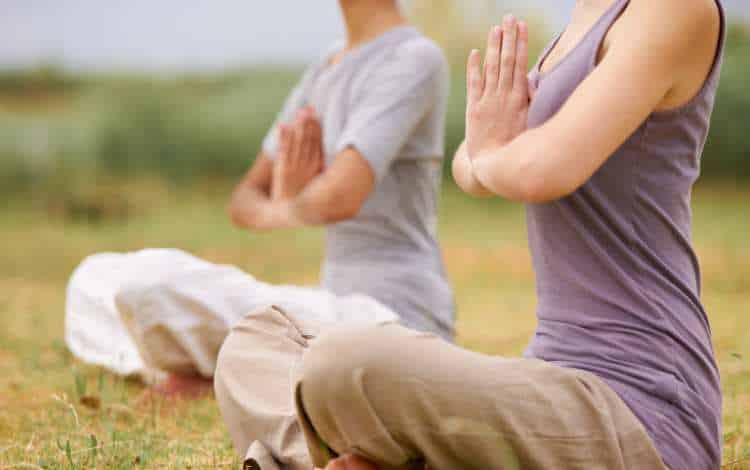
The daily meditation practice starts early in the morning, usually before daybreak. The meditators sit along the walls inside the temple and meditate with their backs as upright as possible and with the chins somewhat tucked in. In Japanese, the word zazen is used for meditation.

After about 45 minutes everyone stands up to continue with walking meditation, for about a quarter of an hour, which in zen is a group practice where the meditators walk clockwise in a circle inside the temple.

It’s really powerful to do both the sitting and walking meditation as a group. This builds up a lot of mental energy which supports concentration. In that respect, group practice makes it easier to meditate.

Read the complete article:
Zen Buddhist Meditation Practice

Three Yogis Meditating

By Remez Sasson

Here is a short funny story about meditation I have found on the Internet.

Three Yogis are doing meditative in a remote cave.

One day a sound is heard from outside the cave. After about six months, one of the yogis says, “Did you hear that goat?” Once again, there was silence.

About a year later, one of the other Yogis says, “That wasn’t a goat; it was a mule.” Again, there was silence.

About two years later the third yogi says, “If you two don’t stop arguing, I’m leaving.”

Source: www.swamij.com/jokes.htm

Guide to Spiritual Communities

The Essential Guide To Spiritual Communities
By Axel Gjertsen

Let’s take a close look at the benefits and challenges associated with staying long term in a spiritual community.

It’s useful to know that there are many types of spiritual communities. Some follow old traditions such as Buddhist monasteries while others are new-age centers, where the community members often follow their own spiritual paths.

Most seekers find it really inspiring to stay in a community. There may be a number of experienced meditators living at the center and the group energy is most conducive to spiritual practice.

The size of the community can make a lot of difference. At a large community with 50-100 residents it may take awhile to get to know all the members while the smaller centers are more personal.

Some communities practice a lot of meditation while others don’t. For example, there are Buddhist monasteries in Thailand where they only meditate for 20 minutes per day.

Of course, if you have the discipline you can always practice on your own. It’s much easier to motivate yourself though if the community has at least 2-5 hours of meditation practice on the schedule.

If you get the chance, join a meditation retreat while staying in the community, even if it’s only a 2-5 day retreat. The mind calms down so much by just living in a spiritual community, that you get more out of short retreats than anyone leading a stressful life outside the community.

Read the Complete Article:
The Essential Guide To Spiritual Communities

Venus is Shining in the Sky

By Remez Sasson

VenusHas anyone raised his or her head up in the evening and looked at the Western sky? If you did, you would have seen a big shining star, like a big lamp in the sky. This is the planet Venus.

In astrology, Venus is associated with femininity, love, marriage, partnerships and art. Why is that so? Maybe the ancients saw that Venus shone so beautifully and so brightly and therefore associated it with love and with art. Maybe because it always appears close to sun, before it, or after it, never far from it, and so thoughts there were in some sort of relationships.

It is interesting what the ancients thought when they looked at the sky at night. They must have been in awe, fascination and admiration. They certainly looked at the stars every night, unlike present society, because they lived closer to nature. There was no electricity, and therefore no lights to dim the light of the stars. It must have been absolute darkness at night, so they could see millions of stars.

[Read more...]