
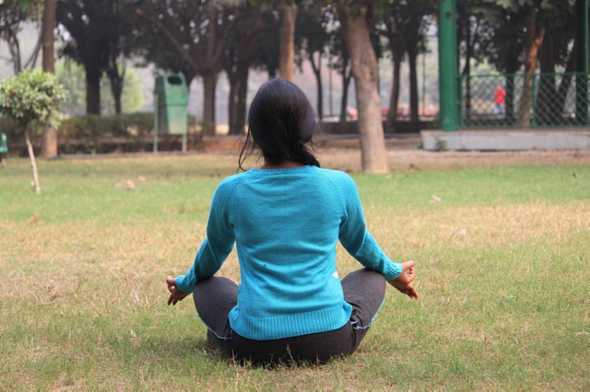
People often ask questions about meditation and visualization. One question appears again and again:
“How can I meditate or visualize without words? My practice is always accompanied by explanatory talk in my mind, and I can’t stop it.”
If you recognize this, you are not alone. Many people have an almost constant habit of verbalizing everything inwardly: describing, explaining, evaluating, comparing, and commenting. This inner talking can feel so natural that you may not even notice it until you try to meditate or visualize seriously.
And then you discover something important:
When you attempt to concentrate, your attention is pulled away by the mind’s ongoing commentary.
This article explains why this happens, why it matters, and how to gradually learn to visualize and meditate with far fewer words—sometimes with none at all.
The Inner Narrator Habit
Download this free 3-step guide and start building focus and inner calm in just 5 minutes a day.
**Get the Free Guide**
Most people have been trained since early childhood to process experience through words.
Words are essential for communication, learning, planning, and daily functioning. But the mind often overuses them. It doesn’t only use words when needed. It uses words almost all the time.
This shows up as:
- describing what you see and do
- repeating what you should do
- commenting on what is happening
- analyzing your mood
- judging whether something is “good” or “bad”
- asking, “Am I doing this right?”
This is not “wrong.” It is simply a habit that is deeply rooted and reinforced.
However, during visualization and meditation, this habit becomes a distraction.
Does Your Mind Jump From One Thing to Another, Making It Hard to Get Things Done?
Focus is a skill you can train. Learn practical techniques and exercises to sharpen your attention, resist distractions, and get more done — in any area of your life.
Discover the Book →Instead of giving full attention to your inner image or your chosen focus, part of your attention is spent on describing and narrating. The practice becomes less direct.
Meditating and Visualizing With Words
Take a moment and observe what happens when you visualize.
If you visualize a beach, do you actually see a beach in your mind—its colors, movement, atmosphere?
Or do you mostly describe it inwardly?
Many people do something like this:
“Now I’m seeing the ocean… the waves are calm… the sand is golden…”
Beyond the Ordinary Mind
One short story, insights, guidance, one simple exercise, delivered weekly. It takes about 10-15 minutes and shifts how you see everything.
**READ A FREE LESSON**
The intention is good, but the mind is busy talking about the image rather than resting in the image.
The same happens in meditation. You try to sit quietly, and the mind begins to comment:
“I should relax… I’m not relaxed… I’m doing it wrong… I need to stop thinking…”
This inner narration turns the practice into a mental conversation.
And the problem is not only that the words exist—the problem is what they do to your attention.
Words pull attention toward themselves.
Why Words Can Limit the Practice
The mind has been taught to think in words, but words are not the only way the mind can know.
A picture can communicate more than a description. A direct experience can be richer than a verbal explanation.
Think of simple examples:
When you look at a beautiful view, you can either:
- enjoy it directly, or
- start analyzing it in words
You can stand before a sunset and simply see it without inner commentary. The moment is complete without explanation.
Or consider love. When you feel love, you can:
- experience it directly as a feeling, or
- try to describe and analyze it while it is happening
In both situations, words are not necessary.
The same principle applies to meditation and visualization.
When words lessen, the experience becomes more direct.
The Real Issue: Attention Gets Split
The biggest difficulty is not “words.” It is scattered attention.
If you use words while visualizing, your attention is divided:
- part tries to form a mental image
- part tries to describe the mental image
If you use words while meditating, your attention is divided:
- part rests in your chosen focus
- part comments, evaluates, and asks questions
This splitting weakens concentration.
And because attention is the fuel of both visualization and meditation, improving attention changes everything.
The Power of Focus and Attention
Visualization—and even more, meditation—requires the ability to focus attention steadily.
This is concentration: the ability to hold the mind on one subject while ignoring irrelevant thoughts.
Concentration gathers mental energy. It stops the constant leaking of attention into:
- commentary
- analysis
- unrelated thoughts
- inner argument
When concentration increases, the inner verbalizing naturally decreases. Not because you force it, but because attention becomes steadier and more absorbed.
This is why there are no true shortcuts here.
To reduce the habit of inner narration, you strengthen the mind’s capacity to stay with one thing.
Why This Habit Is So Persistent
Inner verbalizing is persistent because it is tied to several mental tendencies:
- The mind likes to feel in control
- The mind believes it must “manage” the practice
- The mind wants reassurance: “Am I doing this correctly?”
- The mind is used to constant activity
This is why simply commanding yourself, “Stop the words!” rarely works. It can even create more tension.
The correct approach is calmer:
- notice the habit
- return attention to the practice
- continue patiently
Over time, the habit weakens.
Does Your Mind Jump From One Thing to Another, Making It Hard to Get Things Done?
Focus is a skill you can train. Learn practical techniques and exercises to sharpen your attention, resist distractions, and get more done — in any area of your life.
Discover the Book →How to Visualize or Meditate Without Words
Below are practical steps that stay faithful to the original approach, while adding helpful detail and structure.
1) Train your mind with concentration exercises
If you want fewer words during visualization and meditation, you must build concentration.
Even a few minutes a day makes a difference.
Simple concentration training:
- focus on your breath
- focus on a candle flame
- focus on a single word (briefly), then drop it and remain quiet
- focus on a simple object in your mind (a circle, a dot, a rose)
The purpose is not to succeed perfectly. The purpose is to train returning.
Each time the mind wanders, you return. That return strengthens you.
If you wish to learn to focus your mind, check or book How to Focus Your Attention.
2) Set the intention before you begin
Before you meditate or visualize, take 10–20 seconds and set a clear direction:
- “This time I will focus more deeply.”
- “This time I will reduce inner commentary.”
- “This time I will rest in the experience instead of describing it.”
Repeat this quietly a few times before you start.
This prepares the mind and reduces the tendency to narrate automatically.
3) Catch the words early—without frustration
When you notice yourself talking inwardly, do not become annoyed.
Anger and disappointment only add more mental activity.
Instead:
- notice it
- accept that it happened
- return to the image or the meditation focus
The key is the attitude: gentle correction, not inner struggle.
4) Cultivate a more peaceful mind
A restless, tense mind needs to talk. It uses words as movement.
A more peaceful mind has less need to comment and explain.
This is why practices that calm the mind help you reduce inner narration.
Even a small degree of inner peace improves your chances of meditating and visualizing with fewer words.
5) For visualization: look at the mental image, not the description
When you visualize, treat the mental image as a picture.
Instead of describing it, simply observe it.
Make it more vivid by adding details without words:
- shape
- color
- distance
- movement
- atmosphere
If words arise, let them pass and return to “seeing” the image.
A helpful trick:
- focus on one visual detail at a time (for example, the color of a door, the texture of a leaf, the shine of water)
This gives attention something direct to do without narration.
6) For meditation: stop checking whether you are doing it correctly
One of the biggest sources of inner words in meditation is self-monitoring:
- “Am I doing it right?”
- “Is my mind too active?”
- “Is this working?”
These questions are still thoughts. They pull you away from practice.
Instead:
- choose one simple focus (breath, sensation, stillness, a point of attention)
- rest attention there
- when words arise, return without judgment
Meditation is not improved by constant evaluation. It is improved by calm persistence.
A Simple Practice You Can Try Today – The “Wordless Minute”
Once a day, practice one minute of wordless attention.
- Sit comfortably.
- Choose a simple focus: the breath, a physical sensation in the hands, or a visualized dot of light.
- For one minute, do not fight words.
- Each time you notice narration, return attention to your focus.
One minute is enough to begin training the habit.
Over time, increase to two minutes, then five.
Short daily practice is more effective than long occasional practice.
What Changes When Words Become Quieter
When inner verbalizing lessens, something becomes obvious:
- you perceive faster
- you understand with less effort
- you become less mentally crowded
- attention becomes steadier
- practice feels more natural
The goal is not to hate words. Words are useful. The goal is to stop allowing words to dominate inner experience when they are not needed.
Quotes on the Mind, Meditation, and Thinking
“Meditation gives you an opportunity to come to know your invisible self. It allows you to empty yourself of the endless hyperactivity of your mind, and to attain calmness.”
— Wayne Dyer
“The more tranquil a man becomes, the greater is his success, his influence, his power for good.”
— James Allen
“Our thinking minds deprive us of the happiness that comes when we are living fully in the moment.”
— Ram Dass
FAQ: Visualizing and Meditating Without Words
Is it normal to have words in meditation and visualization?
Yes. Inner narration is a common mental habit. The practice is not to “never think,” but to return attention again and again until the habit weakens.
Should I force the mind to stop talking?
No. Forcing creates tension. A better approach is to notice the narration and return calmly to your focus.
What helps most to reduce inner narration?
Concentration training. The stronger your attention, the less the mind feels the need to explain, analyze, and comment.
Does wordless meditation mean the mind becomes blank?
Not necessarily. Thoughts may still arise. The difference is that you stop being carried away by them, and the mind becomes quieter and steadier.
Final Thoughts
To visualize and meditate without words, you do not need a complicated method. You need to understand the habit of inner narration and train your attention patiently.
Words are useful, but they are not always necessary.
When attention grows stronger and the mind becomes calmer, words naturally quiet down. Then visualization becomes more vivid, meditation becomes more direct, and inner experience becomes simpler and deeper.
Continue Training the Mind Beyond Words
Learning to meditate and visualize without words is not about forcing silence — it is about strengthening attention and calming the inner activity of the mind.
If you would like guided, practical training to deepen focus, reduce mental chatter, and cultivate inner calm in everyday life, explore our book How to Focus Your Attention.
It offers simple, step-by-step exercises designed to help you develop concentration naturally and experience greater mental clarity without strain.
This is a deeply embedded habit, and while it is helpful for certain activities, you don’t need it when visualizing or meditating. Actually, you focus better without words.
Does Your Mind Jump From One Thing to Another, Making It Hard to Get Things Done?
Focus is a skill you can train. Learn practical techniques and exercises to sharpen your attention, resist distractions, and get more done — in any area of your life.
Discover the Book →Refined and updated with practical wisdom for 2026 by Remez Sasson.
If you find this content helpful, we would truly appreciate it if you mention or link to SuccessConsciousness.com.
About the Author
 Remez Sasson is the founder of SuccessConsciousness.com, a global resource established in 2001. With decades of personal experience and 25 years of professional digital publishing he has written many articles, and created 11 eBooks, and 16 digital courses. His teachings have helped readers worldwide cultivate inner peace, self-mastery, and inner strength, empowering them to effectively shape their lives.