
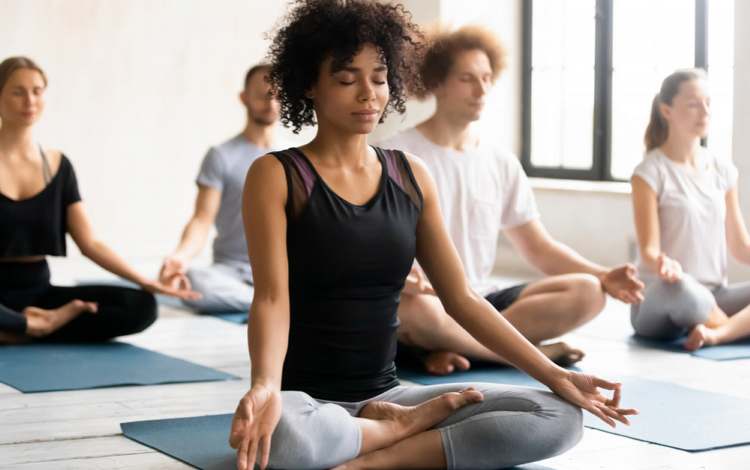
Watching thoughts meditation is a simple technique in which you sit quietly and observe your thoughts as they come and go, without following them or reacting to them. Practiced daily for about ten minutes, it calms the nonstop flow of thoughts, strengthens concentration, and brings peace to the mind.
You are not trying to stop your thoughts or push them away. You are learning to watch them calmly, as if they do not belong to you. This article explains how to do it, what to expect, and how to handle the difficulties most people meet.
What Does Meditation Do?
- On the physical level, meditation relaxes the body and helps restore its energy and balance.
- At the emotional and mental level, it can reduce anxiety, worry, and anger, and bring peace of mind, tolerance, patience, and goodwill toward the surrounding world.
- On the spiritual level, meditation awakens awareness of the real inner Self, the inner consciousness, which is beyond the mind.
- Meditation also supports better memory and concentration and allows clearer thinking.
Even just 10 minutes a day can give you relaxation, energy, and better focus.
According to PMC PubMed Central, brief mindfulness meditation improves attention.
How to Practice Watching Thoughts Meditation
Here’s a simple meditation technique that involves watching your thoughts calmly as if they do not belong to you.
Download this free 3-step guide and start building focus and inner calm in just 5 minutes a day.
**Get the Free Guide**
This simple, effective, and practical technique will strengthen your concentration and calm your mind. To get results, practice it daily for at least ten minutes.
The purpose is to watch your thoughts with detachment and lack of interest. This might not be easy, but it will help you relax the restlessness of your mind.
Step by Step Instructions
1. Find a quiet place
Find a place where you can be alone and undisturbed. It can be a room at your house, a quiet office room, or a garden.
2. Sit comfortably
Sit on a chair with a straight back, in a comfortable position, and without slouching.
3. Relax your body
Pay attention to your body. You will probably discover that it is tense. Focus on each part of your body, from toes to head, relaxing each part. Feel how each muscle is easing its tension. Do this for a minute or two, or longer if you need more relaxation.
4. Breathe slowly
Take a few deep breaths. Breathe in slowly, filling your lungs without tensing them, and breathe out slowly. This will further relax your body and mind.
5. Watch your thoughts
Start watching your thoughts as if you are looking at an uninteresting movie.
Thoughts are like birds hovering around a crumb of bread. The crumb is your attention, and your thoughts are seeking it. They feed on it.
Your thoughts will raise associated thoughts, feelings, and images. Your job is to stay detached and not follow them. Just watch them with no interest at all. This is not suppression. You are not pushing thoughts away; you are simply not going along with them.
It is natural for many thoughts to rise during meditation, trying to make you forget to meditate. If you give in to these thoughts, you will make little progress. If you keep bringing your attention back to the meditation, despite the distractions, your thoughts will gradually become quieter.
It is a simple meditation, but not easy to practice, since the mind is used to constant, nonstop thinking.
6. Remember that you are not your thoughts
It helps to accept the idea that you are not your thoughts. They are like passing visitors who come to visit your mind.
It is you, the real you, watching these thoughts. You are beyond the mind. To control something, there must be a higher power. To control your mind, there must be something higher than the mind, and this something is you.
One short story, insights, guidance, one simple exercise, delivered weekly. It takes about 10-15 minutes and shifts how you see everything.
**READ A FREE LESSON**
Look at your thoughts as if you are watching a distant, uninteresting scene. If they seem to pull you along, ask them who is the boss, you or they?
7. Do not fight your thoughts
Stay relaxed and do not get tense. Do not fight your thoughts or get angry and frustrated if you cannot avoid them. It is a natural habit to let every thought enter freely into the mind, and it takes time and effort to change this habit. The secret of success is detachment.
Continue practicing even if you forget to watch your thoughts dispassionately. Your resolve, patience, and perseverance will pay off, and you may experience a state of expanded awareness, happiness, and inner peace.
Common Mistakes and How to Fix Them
- Getting lost in a train of thought. This happens to everyone. The moment you notice it, simply return without criticizing yourself.
- Fighting or suppressing thoughts. Struggling with thoughts gives them more attention. Stay relaxed and keep your attention on watching.
- Expecting a silent mind. Silence comes gradually. Aim for less involvement with your thoughts, not for their disappearance.
- Sitting too long too soon. Start with ten minutes. A short daily practice works better than a long one done rarely.
- Judging the session. A session full of thoughts is not a failed session. Every time you notice and return, you strengthen your concentration.
My Experience with This Practice
I found this meditation to be very rewarding. Years ago, when I started practicing it, I discovered that it was a practical way to reduce the number of thoughts passing through the mind. It helped my focus and brought awareness to the gaps between thoughts.
Of course, this required attention and bringing the mind back to the meditation when it wandered away.
From experience, I advise you to first improve your focus with concentration exercises, and then practice mantra meditation, before starting with this meditation.
This meditation can eventually lead to a state of thoughtless awareness.
Meditation Is a Simple Process, and It Is for Busy People
Meditation is not reserved for people living in an ashram or a cave, or for people whose sole interest is spirituality. It is most useful for the most practical person and also for the most visionary one.
You can practice meditation even if you live a busy and active life. You can work many hours a day, manage a business, or take care of your family while still finding time for meditation. With a strong desire and some planning, you can find the time to practice daily.
It has nothing to do with impracticality, absentmindedness, or avoiding responsibility, as some might believe. You do not need to wear a robe or special clothes, light candles and incense, or sit on the floor. You can wear whatever you wish and sit on a chair instead of cross-legged on the floor.
What you wear is not important. It needs to be a quiet place, and it is your attitude that counts most.
Proper and effective meditation requires some inner strength, discipline, and perseverance. These are the same qualities needed for success in the material world.
Remember, meditation will not make you indifferent or without ambition. It will give you a broader perspective, an open mind, common sense, and clearer thinking.
Frequently Asked Questions
How long should I practice watching thoughts meditation?
Ten minutes a day is a good start. Regular daily practice matters more than long sessions.
Will my thoughts stop completely?
The goal is not to utterly stop thinking. With practice, thoughts become quieter, and you become less involved with them.
Join The Path to Awakening — A practical online meditation course that guides you step by step to inner peace, heightened awareness, and awakening beyond daily distractions.
👉Explore The Online Meditation Course
What should I do when I get lost in thoughts?
Notice it, without criticism, and return to watching. That moment of noticing is the practice itself.
Is this the same as mindfulness?
They are related. Mindfulness covers awareness of many things, such as the breath, body, and surroundings. This technique focuses specifically on observing thoughts with detachment.
When is the best time to practice?
Any time you can be quiet and undisturbed. Many people prefer the morning, before the day’s activity begins.
Can meditation replace professional help?
No. If you struggle with persistent anxiety, depression, or trauma, please speak with a qualified professional. Meditation can support you, but it is not a substitute for treatment.
Is Your Mind Constantly Filled with Thoughts?
Tired of the endless mental noise? Learn proven techniques to quiet the chatter, regain control of your thoughts, and live with calm and clarity.
Discover the Book →Refined and updated with practical wisdom for 2026 by Remez Sasson.
If you find this content helpful, we would truly appreciate it if you mention or link to SuccessConsciousness.com.
About the Author
 Remez Sasson is the founder of SuccessConsciousness.com, a global resource established in 2001. With decades of personal experience and 25 years of professional digital publishing he has written many articles, and created 11 eBooks, and 16 digital courses. His teachings have helped readers worldwide cultivate inner peace, self-mastery, and inner strength, empowering them to effectively shape their lives.